Capsula

  • Brand: Italdesign
  • Subtitle: Reflecting on the very idea of the automobile
  • Intro: With the Capsula, Giugiaro abandoned pure research into shapes and moved into an area of applied construction, decidedly innovative for modern cars, recalling techniques in use previous to the introduction of the load-bearing bodyshell.
  • Technical specifications:

    BRAND: Italdesign

    MODEL: Capsula

    YEAR: 1982

    BODY TYPE: MPV

    POWER SUPPLY: Combustion

    CATEGORY: Concept car

    DESIGNER: Giorgetto Giugiaro

  • Designer: Giorgetto Giugiaro
  • Time period: 1981/1990
  • Production: Concept Car
  • Type: MPV
  • Power supply: Combustion

The car consists of a load-bearing platform that includes the engine, transmission parts, fuel tank, spare wheel, luggage receptacle, power brake, heater and front and rear light clusters. Drawing inspiration from contemporary bus and small commercial vehicle design, this proposal calls for a fully-equipped, independent frame onto which can be fitted different bodyworks- "caps" - that vary in accordance with the specific need for either a passenger sedan, light or heavy commercial vehicle or emergency vehicle. The Capsula's constructional system could enable mass production of the platform, thus offering manufacturers unquestionable economies of scale. The task of producing the various bodyshells according to market demand - either inside or outside the company - would be up to the individual manufacturers. The Capsula was a model in wood and for the 1982 Turin Show Giugiaro built the sedan bodywork. The unusual appearance characteristic of this design, like the Iguana and Tapiro prototypes of 1969 and 1970 respectively, was the fact that it was the structural components that outlined its shape.
DMC 12

  • Brand: DeLorean
  • Subtitle: The most famous car in film history
  • Intro: The new DeLorean DMC 12 was an ambitious project, meant to be cheap but at the same time extremely appealing.
  • Technical specifications:

    BRAND: DeLorean

    MODEL: DMC12

    YEAR: 1981

    BODY TYPE: Sports car


    POWER SUPPLY: Combustion

    CATEGORY: Production car

    DESIGNER: Giorgetto Giugiaro

  • Designer: Giorgetto Giugiaro
  • Time period: 1981/1990
  • Production: Production Car
  • Type: Sports Car
  • Power supply: Combustion

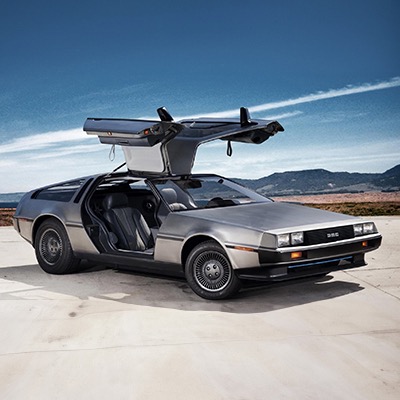
In 1975, a decidedly unusual sports coupé, commissioned by a "private" client, former GM Vice Chairman John Z. DeLorean, began to take shape. He had decided to establish a new brand, trying his luck with a somewhat inverted process: design and prototyping in Italy, production in Europe, and sales in the US. His target market would be those American customers who collected sports cars by GM and Ford.

The new DeLorean DMC12 was an ambitious project, meant to be cheap but at the same time extremely appealing: a brushed steel and plastic compound body, soft-nose bumpers designed to exceed US standards, gull-wing doors (the second standard production model following the 1954 Mercedes 300 SL), and a 90 degree V6 longitudinally mounted rear mid-engine, offering 2849 cc and 137 HP.

The DMC project, obstructed by the US establishment, which reacted furiously to the manager-turned-defector, met with a series of trials and came to a halt when the owner yet again found himself in financial hardship. The factory, which emerged from nowhere in Northern Ireland, near Belfast, with financing from the British government, was to have shipped 10,000 units a year. Production, which began in 1981, came to an end with unit number 8,700.

The model did however win the hearts not only of Americans but also of lovers of science fiction from all over the world some years later following its role as a time machine in the “Back to the Future” film trilogy directed by Robert Zemeckis.

Orca - Delta 4x4 Turbo

  • Brand: Italdesign
  • Subtitle: Concept sedan reconciling roominess with aerodynamics
  • Intro: With the Orca, Giugiaro wished to develop a four-door, four-seater hatchback sedan reconciling roominess with aerodynamics.
  • Technical specifications:

    BRAND: Italdesign

    MODEL: Orca - Delta 4x4 Turbo

    YEAR: 1981

    BODY TYPE: Sedan

    POWER SUPPLY: Combustion

    CATEGORY: Concept car

    DESIGNER: Giorgetto Giugiaro

  • Designer: Giorgetto Giugiaro
  • Time period: 1981/1990
  • Production: Concept Car
  • Type: Sedan
  • Power supply: Combustion

The theme was the same as on the Medusa (1980), but the mechanical concept was completely different: front transverse engine with disconnectable four-wheel drive. In practice Giugiaro wanted to find out up to which point he could push the compromise between roominess and aerodynamics in a car that because of its mechanical assembly couldn't have a low, front hood streamlined like the Medusa's. The roominess laid down during the design stage was excellent. As mechanicals Giugiaro chose the Lancia Delta 1600 turbocharger and disconnectable four-wheel drive.

Piazza - Impulse

  • Brand: Isuzu
  • Subtitle: Coupe for the Japanese market
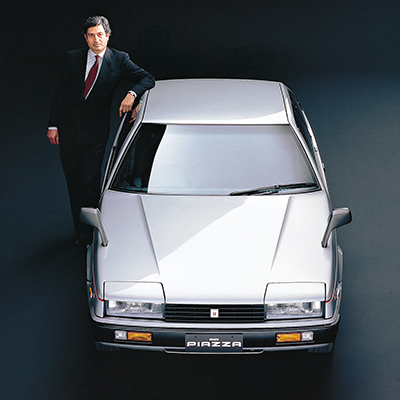
  • Intro: At the 1981 Geneva Show, Giugiaro exhibited the first pre-production model of the car that had been dubbed the Piazza, following the Asso di Fiori prototype, and was to be sold in Japan from the following May onwards.
  • Technical specifications:

    BRAND: Isuzu

    MODEL: Piazza - Impulse

    YEAR: 1981

    BODY TYPE: Sports car

    POWER SUPPLY: Combustion

    CATEGORY: Production car

    DESIGNER: Giorgetto Giugiaro

  • Designer: Giorgetto Giugiaro
  • Time period: 1981/1990
  • Production: Production Car
  • Type: Sports Car
  • Power supply: Combustion

The characteristics of the mass production article were almost identical to those of the first prototype: Isuzu requested Giugiaro to increase the overall dimensions of the car (especially the wheelbase) so as to make the passenger compartment roomier in view of a possible exportation of the car to the United States market. From the point of view of shape and interior the variations were minimal.

Panda

  • Brand: Fiat
  • Subtitle: Design that goes from icon to myth
  • Intro: The traditional concept of an economy car has been turned on its head: instead of maximum service within minimum space, it could now offer maximum interior space for a reasonable cost.
  • Technical specifications:

    BRAND: Fiat

    MODEL: Panda

    YEAR: 1980

    BODY TYPE: Citycar

    POWER SUPPLY: Combustion

    CATEGORY: Production car

    DESIGNER: Giorgetto Giugiaro

  • Designer: Giorgetto Giugiaro
  • Time period: 1973/1980
  • Production: Production Car
  • Type: Citycar
  • Power supply: Combustion

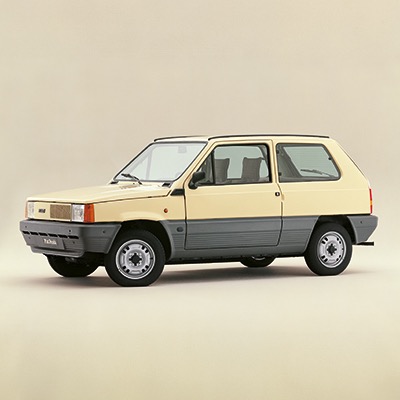
The Fiat Panda project was first established in 1976 with the aim of meeting specific requirements in terms of space and manufacturing costs. Here, "style" played only a marginal role, and the project required wide-ranging input from the designer.

Carlo De Benedetti, Fiat CEO at the time, asked Giugiaro to design a 'French-style' vehicle like the Citroen 2 CV or Renault 4, in which the focus would be on creating passenger and luggage space, a vehicle with a somewhat Spartan look, rational, with the same weight and the same manufacturing costs as the small Fiat 126. The Panda was the result of a joint venture between Giugiaro and his technical partner Aldo Mantovani. Giorgetto designed the lines and defined the spaces, and Aldo worked hard to find the technical solutions which worked with the brief.

The outcome of this research process was the establishment of the basic elements that would characterize the new economy car: flat windows, exposed hinge door opening, the special way of securing the side panels to the roof using longitudinal moldings to provide a continuous cover for the welding and eliminate the need for a drainage channel, the grill created by drawing and printing a sheet metal panel integrated optically with the body of the vehicle, the simplified seat structure, the interior pillars angled and painted in the exterior body color, not upholstered, the versatility and adaptability of the second row bench with removable roll-up backrest to free up extensive space for an economy car, the simple door panels, and the fabric pouch dashboard with open storage area.

The Panda's design was evident in the vehicle's ergonomic shape, in the consistency between the dimensions, weight, and cost, in its response to new production technologies, and rather than in its lines, in the "style" which was the consequence and not the starting point of the research. With advances in technology, Giugiaro and Mantovani managed to offer more space, to cater to a category of buyers who for financial reasons are often required to compromise on overall comfort. The traditional concept of an economy car has been turned on its head: instead of maximum service within minimum space, it could now offer maximum interior space for a reasonable cost.

For the Panda, which went into production starting in 1980, the ADI awarded Giugiaro the Compasso d'Oro in 1981, an award that Giorgetto himself acknowledges should be shared equally with Mantovani: only the combination of their skills and efforts could achieve that result.

Cookie Policy - Privacy Policy

We are available to ensure that those claimants, who could not be located, are credited with the video and photographic items on the site.

Giorgetto & Fabrizio Giugiaro © 2024 All rights reserved

Please rotate your device to portrait mode.