Iso Grifo Spider

  • Brand: Iso Rivolta
  • Subtitle: A good companion for the Iso Grifo coupe
  • Intro: A one-off owned by Renzo Rivolta, founder of Iso in Italy.
  • Technical specifications:

    BRAND: Iso Rivolta

    MODEL: Iso Grifo Spider

    YEAR: 1964

    BODY TYPE: Sports car

    POWER SUPPLY: Combustion

    CATEGORY: Concept car

    DESIGNER: Giorgetto Giugiaro

  • Designer: Giorgetto Giugiaro
  • Time period: 1955/1965
  • Production: Concept Car
  • Type: Sports Car
  • Power supply: Combustion

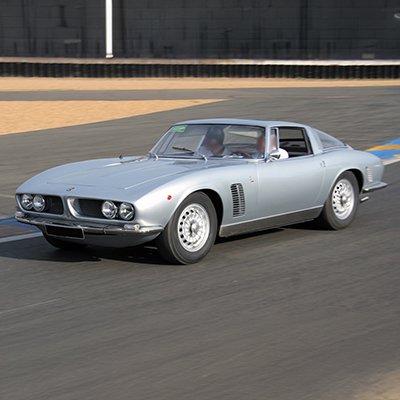
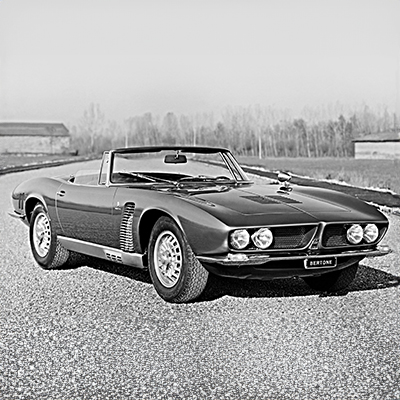
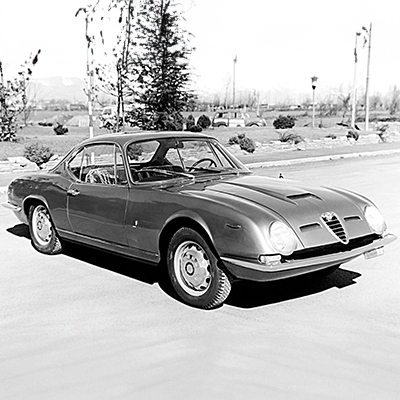
A one off with several features not on the production steel bodied coupes. Among them: side vents aft of the rear wheels cut into the fender; a vertical slot on the front fenders with horizontal “blades” almost hiding vertical exhaust pipes, one per side; a dull-finished rocker panel; counting slots, ostensibly for exhaust.
Giulia GT

  • Brand: Alfa Romeo
  • Subtitle: Simple and refined at the same time
  • Intro: The new benchmark in its category, becoming one of the most coveted cars of the period, both for the modernity of its line and for its sports car performance tout court.
  • Technical specifications:

    BRAND: Alfa Romeo

    MODEL: Giulia GT

    YEAR: 1963

    BODY TYPE: Sports car

    POWER SUPPLY: Combustion

    CATEGORY: Production car

    DESIGNER: Giorgetto Giugiaro

  • Designer: Giorgetto Giugiaro
  • Time period: 1955/1965
  • Production: Production Car
  • Type: Sports Car
  • Power supply: Combustion

The Alfa Romeo Giulia GT is a coupe derived from the Giulia built by Alfa Romeo between 1963 and 1975. The Giulia GT was intended to replace the Giulia Sprint 1600, from which, however, it retains the general body layout and also the classic engine and front gearbox placement with rear-wheel drive.

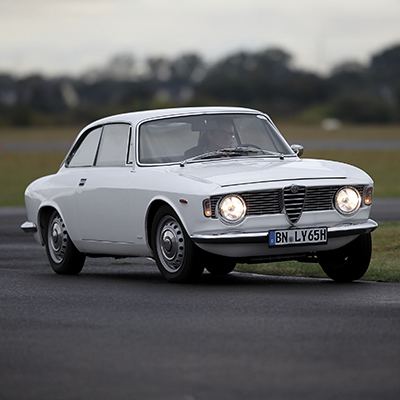
The Giulia Sprint GT is compact, streamlined, simple and refined at the same time, with a clever play on proportions. Compared with the Giulietta, one notices that the fenders have practically disappeared from view.

Giorgetto Giugiaro takes a cue from one of his earlier creations, the 2000 Sprint of 1960: on the new coupe, too, the wide curved pavilion is striking, guaranteeing, in fact, roominess for four people. The modernity of the design is represented by the taut sides interrupted by a dihedral. The front end is also innovative, with a wide rectangular grille encompassing the Carello headlamps, surmounted by a sheet metal bordered by two oblique sections.The curious front "step" that characterizes all versions produced until 1968 and part of those produced until 1971 was due to an afterthought between the approval of the design and the car's production run. It was originally intended to be an air intake, later abolished to keep costs down, which by leaving room for the "step" defined an important (and recognizable) styling feature.

The Alfa Romeo Giulia Sprint GT was previewed to the press on September 9, 1963, and three days later the official presentation to the public took place at the Frankfurt Motor Show. Its debut was phenomenal: it amazed everyone, both for the modernity of its line and for its sports car performance tout court. It was the new benchmark in its category and became one of the most coveted cars of the period.

Iso Grifo

  • Brand: Iso Rivolta
  • Subtitle: The allure of the berlinetta
  • Intro: A car that turns out to be a middle ground between large American coupes and sleek European sports sedans, managing to concentrate the comfort and reliability of one with the elegance and performance of the other.
  • Technical specifications:

    BRAND: Iso Rivolta

    MODEL: Iso Grifo

    YEAR: 1963

    BODY TYPE: Sports car

    POWER SUPPLY: Combustion

    CATEGORY: Production car

    DESIGNER: Giorgetto Giugiaro

  • Designer: Giorgetto Giugiaro
  • Time period: 1955/1965
  • Production: Production Car
  • Type: Sports Car
  • Power supply: Combustion

Iso's intention, in launching the design of the "Grifo”, was to make a car that would be a cross between the mammoth American coupes and the sleek European sports sedans, managing to concentrate, without too many sacrifices or excesses, the comfort and reliability of the one, with the elegance and performance of the other.

The difficult work was entrusted, for the technical part, to Giotto Bizzarrini, a famous designer and former Alfa Romeo and Ferrari consultant, joined by Bertone and Giugiaro for the aesthetic part. The new model was ready in a few months, as it was decided to proceed by shortening the chassis of the "GT" and was presented at the 1963 Turin Motor Show, under the name "A 3 L Grifo”.

As soon as the road model was defined, Giotto Bizzarrini devoted all his energy to the racing version, named "A 3 C”. The bodywork was lightened and the distribution of masses was varied, through the retreat of the engine. Bizzarrini's clear goal was to succeed, in a short time, in making a car that could compare with the Ferrari 250 GTO.

The Grifo is a low, streamlined 2-seater coupe with a long hood and set-back passenger compartment with a large glass area and tapering toward the tail. Compared to the GT, the newcomer is a coupe with fastback shapes, whose rear end drops gently toward the hint of a tail while the nose is long and ends in a front end with 2 pairs of round lights.

To true supercar performance the Iso Grifo combines classic luxury car elegance, with a cabin infused with leather and wood and accessories that at the time represented the ultimate, such as electrically operated windows and air conditioning.

2600 Sprint HS

  • Brand: Alfa Romeo
  • Subtitle: The radical version of the 2600 Sprint
  • Intro: The “High Speed” coupe was based on the 6-cylinder Tipo 106 Alfa 2600 but was more radically styled. In remained a one-off.
  • Technical specifications:

    BRAND: Alfa Romeo

    MODEL: 2600 Sprint HS

    YEAR: 1963

    BODY TYPE: Sports car

    POWER SUPPLY: Combustion

    CATEGORY: Concept car

    DESIGNER: Giorgetto Giugiaro

  • Designer: Giorgetto Giugiaro
  • Time period: 1955/1965
  • Production: Concept Car
  • Type: Sports Car
  • Power supply: Combustion

In 1960, the 2000 Sprint made its debut: an elegant and luxurious coupe, 700 of which were built up until 1962. That same year, Bertone also created a 4-seater convertible version of the car which however was not produced commercially, and Bertone was also behind the design of the 2000 and the Giulia T.I. In 1963, the Frankfurt Motor Show saw the unveiling of the Giulia GT which replaced the Giulietta Sprint while repeating its enormous success: more than 200,000 of them were built up until 1977. It was also in 1963 that Bertone prepared two cars that were destined to remain one-offs: the 2600 Sprint HS and the Giulia Sprint Speciale.

Luce 1000/1500

  • Brand: Mazda
  • Subtitle: A new subject for Giugiaro: a sedan after many sports cars
  • Intro: The beginning of the collaboration between Giugiaro and the Japanese automaker.
  • Technical specifications:

    BRAND: Mazda

    MODEL: Luce 1000/1500

    YEAR: 1963

    BODY TYPE: Sedan

    POWER SUPPLY: Combustion

    CATEGORY: Concept car

    DESIGNER: Giorgetto Giugiaro

  • Designer: Giorgetto Giugiaro
  • Time period: 1955/1965
  • Production: Concept Car
  • Type: Sedan
  • Power supply: Combustion

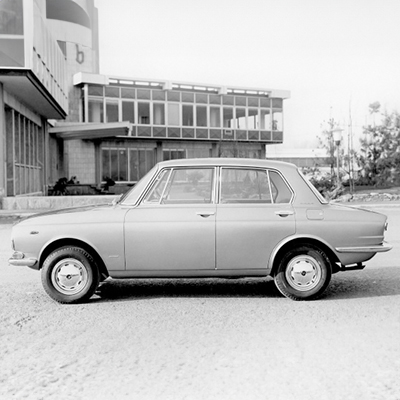
By 1962, the Japanese carmakers had turned towards Italy almost en masse. It started with a Prince Skyline by Michelotti, and soon Nissan was turning to Pininfarina, and Daihatsu to Vignale. Toyo Kogyo (the future Mazda) consulted with Hideyuki Miyakawa, a journalist, entrepreneur and globetrotter who had found home and love in Italy, on their passenger car aspirations. Miyakawa suggested Bertone. The Luce 1000/1500 was shown at the 1963 Tokyo Motor Show. Those fender badges and the Italian name marked this as the first public manifestation of the collaboration between Mazda and Bertone.

Cookie Policy - Privacy Policy

We are available to ensure that those claimants, who could not be located, are credited with the video and photographic items on the site.

Giorgetto & Fabrizio Giugiaro © 2024 All rights reserved

Please rotate your device to portrait mode.