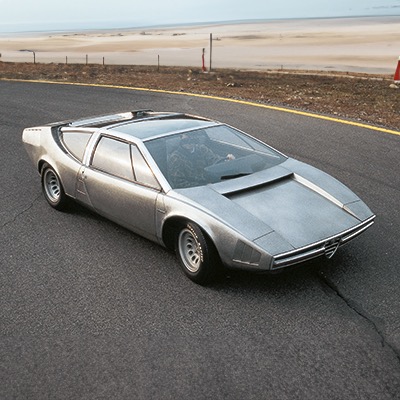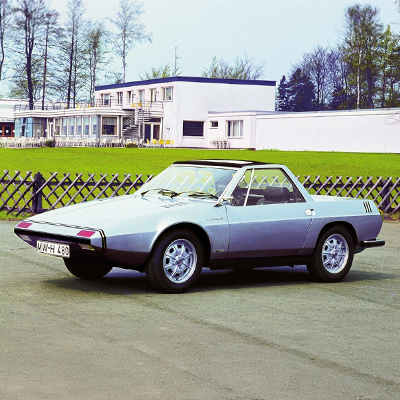
Cheetah

  • Brand: VW Karmann
  • Subtitle: Prototype for a low budget roadster
  • Intro: For the 1971 Geneva Motor Show, Giugiaro was asked by Carrozzeria Karmann to prepare the prototype of a roadster that could be manufactured with a very low budget using components already in production.
  • Technical specifications:

    BRAND: VW Karmann

    MODEL: Chetah

    YEAR: 1971

    BODY TYPE: Sports car

    POWER SUPPLY: Combustion

    CATEGORY: Concept car

    DESIGNER: Giorgetto Giugiaro

  • Designer: Giorgetto Giugiaro
  • Time period: 1968/1972
  • Production: Concept Car
  • Type: Sports Car
  • Power supply: Combustion

With the Cheetah, little known, Giugiaro took another step towards very squared shapes. The car was born almost at the same time as the Alfasud Caimano, that was to be presented two months later at the Turin Motor Show, and shared its layout of shape. Uncluttered side, clean front fender ridge, almost horizontal rear end, vertical tail section.
Tapiro

  • Brand: Porsche
  • Subtitle: Birth of the wedge shape
  • Intro: A concept car that dictates the line that will be followed for more than a decade.
  • Technical specifications:

    BRAND: Porsche

    MODEL: Tapiro

    YEAR: 1970

    BODY TYPE: Sports car

    POWER SUPPLY: Combustion

    CATEGORY: Concept car

    DESIGNER: Giorgetto Giugiaro

  • Designer: Giorgetto Giugiaro
  • Time period: 1968/1972
  • Production: Concept Car
  • Type: Sports Car
  • Power supply: Combustion

1970 was a splendid year for Giugiaro and for the other coachbuilders in Turin.
At that city's motor show Pininfarina exhibited his Ferrari Modulo, a Paolo Martin creation. The Bertone-Gandini duo presented a prototype of the outlandish Lancia Stratos, and Giugiaro’s company showed its Tapiro, a sports car based on the mid-engined VW-Porsche 914-916.

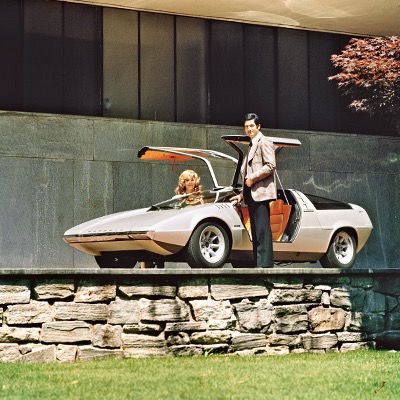
A long, eye-catching central roof strip acted like a metallic backbone to which the doors and the two halves of the engine cover were attached. Both could be lifted up-the aptly named 'gull wing' effect. The wedge-shaped nose with its pop-up headlights and the raised, angled rear end were further stylistic components of the car which, with its low, snuffling nose, recalled the curiosity of a tapir, classy and imposing at the same time.

For Giugiaro, this highly unconventional reinterpretation of the Porsche represented the beginning of that stylistic trend based on straight lines with wedge-shaped fronts and bonnets that visually extend the windscreen, with strong transitions and sharp creases marking the change of planes.

Iguana 33/2

  • Brand: Alfa Romeo
  • Subtitle: The iridescent-looking dream car
  • Intro: The Iguana proposes in a very personal way the theme of the two-seater coupe: sharp, low and sleek at the same time.
  • Technical specifications:

    BRAND: Alfa Romeo

    MODEL: Iguana 33/2

    YEAR: 1969

    BODY TYPE: Sports car

    POWER SUPPLY: Combustion

    CATEGORY: Concept car

    DESIGNER: Giorgetto Giugiaro

  • Designer: Giorgetto Giugiaro
  • Time period: 1968/1972
  • Production: Concept Car
  • Type: Sports Car
  • Power supply: Combustion

The Turin Motor Show in 1969 saw the release of two prototypes from Giugiaro’s company: the Abarth 1600 and the Alfa Romeo Iguana.

No other single Alfa Romeo platform had ever inspired three Turin body shops to such an extent.

Off the back of the sporting success of the 33 Competizione, Alfa Romeo offered the platform of the 33 road version: Bertone and Gandini delivered the Carabo, the metamorphosis of a flamingo; Pininfarina the wedge-shaped P/33, and Giugiaro the Iguana. The name Iguana was chosen because of the similarity between the exotic animal and the appearance of the body with numerous openings and iridescent trim.

On the Iguana you can identify the steel structural elements inside the body. The aim of the designer was to make a connection between the curved sides and the plan view by means of the engine hood and the rear cover. The transparent roof with its strongly rectangular elements helps in this respect, too. The undulating waistline rises toward the rear and blends into the rear window. The front end is rendered visually lighter by the bold rectangular cutout in the center of the hood.

1600 Coupé

  • Brand: Abarth
  • Subtitle: One-off 2+2 coupe
  • Intro: Abarth's last project before becoming part of the FIAT group.
  • Technical specifications:

    BRAND: Abarth

    MODEL: 1600 Coupé

    YEAR: 1969

    BODY TYPE: Sports car

    POWER SUPPLY: Combustion

    CATEGORY: Concept car

    DESIGNER: Giorgetto Giugiaro

  • Designer: Giorgetto Giugiaro
  • Time period: 1968/1972
  • Production: Concept Car
  • Type: Sports Car
  • Power supply: Combustion

Made with the platform and mechanical assembly of the 1600, the idea was a 2+2 coupe for limited production. Instead it never got beyond the one-off stage. The front end was well designed, simple and lithe with a hood fender interaction that was later to be seen on the Maserati Bora. After the pastel green of the Manta, the Abarth 1600 was painted white and was the last Giugiaro’s prototype not to be metallic grey, the color the designer believes to be the most suitable for highlighting the shape of a bodywork. From the Iguana onwards, all the prototypes were painted metallic grey with the sole exception of two Maseratis, the 2+2 coupe and the Medici, both of 1974, still metallic but green, and the New York Taxi, obviously painted yellow.

Carry L40/L40V

  • Brand: Suzuki
  • Subtitle: A symmetrical van previously unseen in the Japanese market
  • Intro: The Suzuki Carry designed by Giugiaro was introduced in July 1969.
  • Technical specifications:

    BRAND: Suzuki

    MODEL: Carry L40/L40V

    YEAR: 1969

    BODY TYPE: Citycar

    POWER SUPPLY: Combustion

    CATEGORY: Concept car

    DESIGNER: Giorgetto Giugiaro

  • Designer: Giorgetto Giugiaro
  • Time period: 1968/1972
  • Production: Concept Car
  • Type: Citycar
  • Power supply: Combustion

In November of the same year, a van version with two opening side doors and a top-hinged rear gate was added. Giugiaro’s design was more obvious in the Carry Van iteration, very symmetrical with similar looks to the front and rear. The L40’s design was not overly utilitarian, limiting interior space and being a bit too modern for the usually very orthodox Japanese commercial customer base.

Cookie Policy - Privacy Policy

We are available to ensure that those claimants, who could not be located, are credited with the video and photographic items on the site.

Giorgetto & Fabrizio Giugiaro © 2024 All rights reserved

Please rotate your device to portrait mode.