Boomerang

  • Brand: Maserati
  • Subtitle: A glimpse into the future
  • Intro: The whole architecture focuses on trapezoid shapes, which distinguish the glazed surfaces of the windshield, of the door windows, and of the rear window.
  • Technical specifications:

    BRAND: Maserati

    MODEL: Boomerang

    YEAR: 1972

    BODY TYPE: Sports car

    POWER SUPPLY: Combustion

    CATEGORY: Concept car

    DESIGNER: Giorgetto Giugiaro

  • Designer: Giorgetto Giugiaro
  • Time period: 1968/1972
  • Production: Concept Car
  • Type: Sports Car
  • Power supply: Combustion

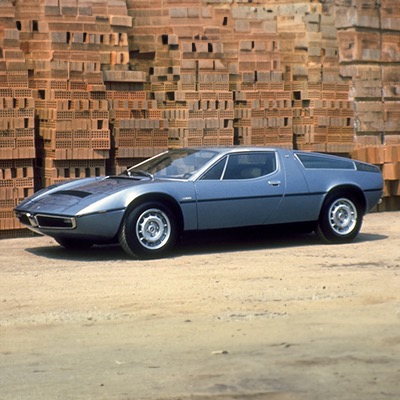
One of the surprises of the 1971 Turin Motor Show was the epowood model of the very unconventional Maserati Boomerang, which was reaffirmed and developed into a moving prototype for Geneva in 1972.

The dream car, original in both its outer form and its passenger compartment solutions, used the Bora's chassis with a 310 HP 8V mid/rear-mounted longitudinal engine. This was a veritable sculpture, able to reach a speed of around 300 km/h. Its wedge-shaped body was dominated by dihedral and trapezoid forms and glass surfaces that stretched from the roof to below the waistline.

An impressive windshield tilt marks the negative record of 13 degrees (it was 15 degrees on the Manta). The whole architecture focuses on trapezoid shapes, which distinguish the glazed surfaces of the windshield, of the door windows, and of the rear window; on the plan, they also distinguish the front profile and mark the perimeter of the wide rear pillar on the sides. To the sides, the enhanced angular profile decidedly tapers the waistline. Provocation continues inside: a massive cylindrical steering column houses the instruments at the center of the steering wheel.
Merak

  • Brand: Maserati
  • Subtitle: 2+2 coupé with increased roominess
  • Intro: An offshoot of the Bora, using some of its chassis and bodywork parts, the Merak was presented at Paris Motor Show in 1972.
  • Technical specifications:

    BRAND: Maserati

    MODEL: Merak

    YEAR: 1972

    BODY TYPE: Sports car

    POWER SUPPLY: Combustion

    CATEGORY: Production car

    DESIGNER: Giorgetto Giugiaro

  • Designer: Giorgetto Giugiaro
  • Time period: 1968/1972
  • Production: Production Car
  • Type: Sports Car
  • Power supply: Combustion

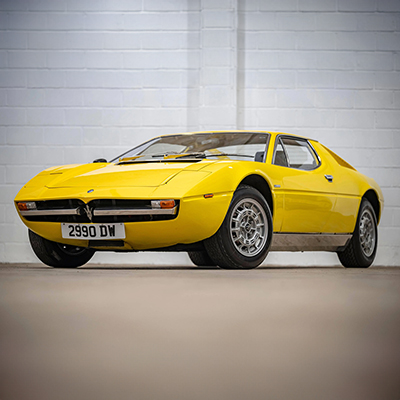
In this specific project Giugiaro didn't have the chance to design a new car, but only to seek a new personality for what, as concerns design, was a simple restyling of the Maserati Bora. Just the rear end received significant modifications: in place of a high and powerful tail (Ghibli and Bora), Giugiaro designed a light rear where a thin pillar connects the far end of the roof to the tail section. This is a classic trait of the Turin designer: to heighten the structural member to a characteristic of shape. From the side, this graphic touch maintains the rear end's idea of continuity, while from behind it creates an unusual effect: the flat engine hood forms a right angle with the base of the rear window.

Alfasud Caimano

  • Brand: Alfa Romeo
  • Subtitle: A concept car out of the box
  • Intro: This car, with its typical wedge-shaped outline, was much admired as a freestyle exercise. The large transparent dome/roof was the eye-catching feature.
  • Technical specifications:

    BRAND: Alfa Romeo

    MODEL: Alfasud Caimano

    YEAR: 1971

    BODY TYPE: Sports car

    POWER SUPPLY: Combustion

    CATEGORY: Concept car

    DESIGNER: Giorgetto Giugiaro

  • Designer: Giorgetto Giugiaro
  • Time period: 1968/1972
  • Production: Concept Car
  • Type: Sports Car
  • Power supply: Combustion

To support the introduction of the Alfasud to the Italian market in 1971, Giugiaro designed the Alfasud Caimano for the Turin Motor Show, using the sedan model's chassis and mechanical assemblies, but with the wheelbase reduced by 205 mm.

Giugiaro requested the Alfa Management's approval to experiment freely on the Alfasud platform. They agreed, but only on the condition that it was self-evident that it was a "dream car”, with no possibility of being put into production in the present or in the future.

This car, with its typical wedge-shaped outline, was much admired as a freestyle exercise. The large transparent dome/roof is the dominating aspect and the emphasis lies with the two rear pillars, which support a rollbar that also acts as a spoiler. The door forms a single whole with the roof/windshield, and it is hinged at the height of the valance. The zenithal form increased the originality of the project, enhancing the seating and the passenger compartment design. The car also features tub-shaped seats and a cylindrical-fashioned dashboard.

Alfasud

  • Brand: Alfa Romeo
  • Subtitle: Function defines style
  • Intro: The first car Giugiaro followed from A to Z. It wasn't just a styling exercise, but rather a car to be invented and transformed, on his own, and accompanied to the assembly line.
  • Technical specifications:

    BRAND: Alfa Romeo

    MODEL: Alfasud

    YEAR: 1971

    BODY TYPE: Sedan

    POWER SUPPLY: Combustion

    CATEGORY: Production car

    DESIGNER: Giorgetto Giugiaro

  • Designer: Giorgetto Giugiaro
  • Time period: 1968/1972
  • Production: Production Car
  • Type: Sedan
  • Power supply: Combustion

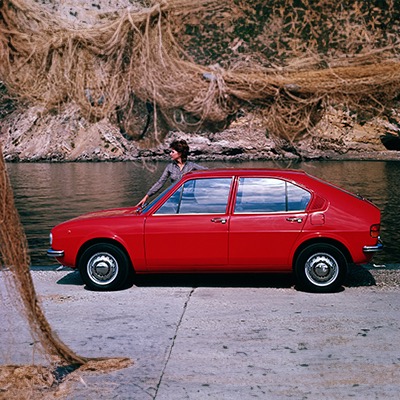
In 1967, Alfa Romeo's President Giuseppe Luraghi had come up with a plan on behalf of IRI, the postwar state-run Industrial Reconstruction Institute: it envisioned the creation of a new factory in Pomigliano d'Arco as a means of generating more jobs in the south of the country, where the industrial structures were weak. When Alfa Romeo President Giuseppe Luraghi made Rudolf Hruska responsible for the Alfasud project, discovering a lack of resources in Arese, the engineer found himself looking for an outsourced party to manage almost the entire order.

Hruska decided to place a number of orders relating to the concept and planning of the future factory in Pomigliano with Giugiaro's young Turin-based company, which was expected to coordinate its work with an Alfa Romeo office opened in the same city. These orders mainly concerned manufacturing methods, value analysis, and the construction of prototypes, but styling, model planning, and model making were also needed. The whole project was directly supervised by Hruska.

For the new compact front-wheel-drive car, Hruska had already finalized the overall dimensions, mechanical elements, luggage space, weight, and production costs, and these parameters could no longer be changed. Hruska's enthusiasm for motor racing was well known, and not surprisingly he kept a close eye on the aerodynamics of the new "berlinetta." It was not until much later that the Alfasud's anticipation of many future design trends became evident. The aerodynamics were convincing, as was the extremely generous interior space and the surprising boot luggage capacity.

Giugiaro is still very fond of Alfasud today: it's the first car he followed from A to Z; so it wasn't just a styling exercise like the ones he had created up until then, but rather a car to be invented and transformed, on his own, and accompanied to the assembly line.

With two- and four-door body styles, the Alfasud was first exhibited in Naples and then at the 1971 Turin Motor Show. The TI version followed in 1973 and the Alfasud Giardinetta (a station wagon) in 1975. The Alfasud Sprint Coupe was launched at the Paris show in 1976. The Spider, however, a highly interesting Giugiaro design, never reached series production. 900,000 cars in this model line were built between 1972 and 1984.

Bora

  • Brand: Maserati
  • Subtitle: Compact and aggressive coupe
  • Intro: The first "all-back" Maserati, created to challenge the powerful rear-engine Ferrari, Lamborghini and De Tomaso.
  • Technical specifications:

    BRAND: Maserati

    MODEL: Bora

    YEAR: 1971

    BODY TYPE: Sports car

    POWER SUPPLY: Combustion

    CATEGORY: Production car

    DESIGNER: Giorgetto Giugiaro

  • Designer: Giorgetto Giugiaro
  • Time period: 1968/1972
  • Production: Production Car
  • Type: Sports Car
  • Power supply: Combustion

Shortly after its acquisition by Citroën in 1968, Maserati proposed a design for a two-seater mid-engine supercar similar to the Lamborghini Miura and De Tomaso Mangusta. Known originally as the Tipo 117 and only later as the Bora, Maserati began study of such a model in October 1968, and the prototype, in its final form, was displayed at the Geneva Motor Show in March 1971: the first sports car in the history of the Trident with a central-rear engine (V8, 4719 cc, 310 bhp at 5000 rpm).

To create a new Maserati two-seater rear-engine coupe which the customer wants to be innovative but not revolutionary and therefore immediately acceptable by the market, Giugiaro started with the Ghibli Ghia, his successful creature.

The raised tail is softened by the elongated second window. The waistline rises towards the rear while the front wing crest has a sinuous silhouette. The low grill on the front refers to the theme of the Ghibli. The roof and windshield pillars are in brushed stainless steel. Although Giugiaro kept to a classic solution, he demonstrated that he did so with extreme professionalism and elegance. 550 models would be manufactured.

Cookie Policy - Privacy Policy

We are available to ensure that those claimants, who could not be located, are credited with the video and photographic items on the site.

Giorgetto & Fabrizio Giugiaro © 2024 All rights reserved

Please rotate your device to portrait mode.