Ghibli

  • Brand: Maserati
  • Subtitle: The consecration of a young master
  • Intro: The curvaceous and powerful Ghibli is Giugiaro's latest coupe to encapsulate the formal tendencies typical of the GTs of the 1960s.
  • Technical specifications:

    BRAND: Maserati

    MODEL: Ghibli

    YEAR: 1967

    BODY TYPE: Sports car

    POWER SUPPLY: Combustion

    CATEGORY: Production car

    DESIGNER: Giorgetto Giugiaro

  • Designer: Giorgetto Giugiaro
  • Time period: 1966/1967
  • Production: Production Car
  • Type: Sports Car
  • Power supply: Combustion

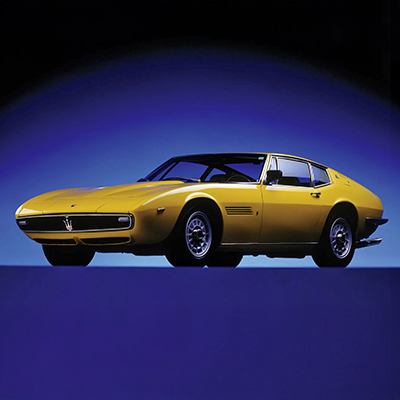
The Ghibli was unveiled on the Ghia stand at the 1966 Turin Motor Show; the name, as was customary for Maseratis at the time, was that of a wind: in this case the Ghibli, dry Libyan sirocco.

These were the years when Lamborghini was offering the Miura to its wealthier and sportier customers, while Ferrari had launched the 365 Gtb: Maserati could not miss the opportunity of such a receptive market, and responded with the Ghibli. The goal, however, was not to offer the fastest car, but rather a powerful model on which to ride in luxury and comfort. For all intents and purposes it was more a new interpretation of the Grand Touring concept than a pure sports car, and although it was the most expensive of the three, it far exceeded the sales of both.

The year 1966 was perhaps one of the most extraordinary years in Giorgetto Giugiaro's creative and design journey: at the same show, in addition to the Ghibli, he presented the De Tomaso Mangusta, the De Tomaso Pampero and the Fiat 850 Vanessa. The French newspaper L'Equipe, in its issue following the Turin show, wrote that that year's edition had two undisputed protagonists: the debut of the Fiat 124 and Giugiaro.

The curvaceous and powerful Ghibli is Giugiaro's latest coupe to encapsulate the formal tendencies typical of the GTs of the 1960s: in the front view the radiator grille that hides the headlights as on Pampero and Mangusta stands out, the longitudinal engine spurred it to trace a generous nose to great scenic effect, the beltline is decidedly animated, the high and full tail is a functional necessity because the two fuel tanks are housed behind the rear deck and have a very high nozzle, while the fuel door is housed in a shallow end that tapers toward the tail.The rear is linear, with a large rectangular rear window and two slender horizontal light clusters, while the bumper turns up almost to the wheel well and contrasts with the front, where it is resolved as the grille surround.

The stylistic element of greatest break with the past, however, is the way the volumes were integrated, seamlessly between body and cabin, joined together as if they were a single surface. The front end also expresses a new stylistic language for the Trident marque, with pop-up headlights and a very subtle grille on taut, geometric lines that Giugiaro's hand nevertheless makes fluid.

The first examples were produced in March 1967, and the Ghibli remained in production until 1973. The Ghibli name would be revived in 1992 for the last version of the Biturbo and in 2013 for the sedan of the same name.

Mangusta Spyder

  • Brand: De Tomaso
  • Subtitle: A show-stopping spider
  • Intro: Designed to put on a show, a unique model, never entered production, with special features.
  • Technical specifications:

    BRAND: De Tomaso

    MODEL: Mangusta Spyder

    YEAR: 1967

    BODY TYPE: Sports car

    POWER SUPPLY: Combustion

    CATEGORY: Production car

    DESIGNER: Giorgetto Giugiaro

  • Designer: Giorgetto Giugiaro
  • Time period: 1966/1967
  • Production: Production Car
  • Type: Sports Car
  • Power supply: Combustion

Some 400 De Tomaso Mangustas were produced but only one Mangusta Spyder.

The idea of making an open version was due to the carmaker De Tomaso's desire to present itself in style, with something that would make a spectacle, at the 1966 Geneva Motor Show.

The Spyder version is made from one of the earliest chassis of the Mangusta, of which it retains basically the same mechanical and aesthetic characteristics, differing only in the more cut-off and horizontal rear end.

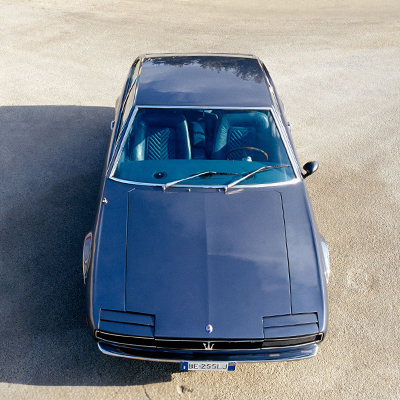
The open version also retains the gull-wing opening of the engine compartment, and comes in a double color scheme of white and red. Particular is the choice, for a spider, to keep the side glazing in its entirety, with the door support intact, connecting the front and rear of the car, as can be seen when observing the Mangusta Spyder with the doors open.

Mangusta

  • Brand: De Tomaso
  • Subtitle: The best compromise between elegance and aggressiveness
  • Intro: One of the most iconic cars designed in the 1960s, a revolution in lines and shapes.
  • Technical specifications:

    BRAND: De Tomaso

    MODEL: Mangusta

    YEAR: 1967

    BODY TYPE: Sports car

    POWER SUPPLY: Combustion

    CATEGORY: Production car

    DESIGNER: Giorgetto Giugiaro

  • Designer: Giorgetto Giugiaro
  • Time period: 1966/1967
  • Production: Production Car
  • Type: Sports Car
  • Power supply: Combustion

The mongoose is an animal capable of killing cobras. Legend has it that the car was named after a failed deal between entrepreneur and racing driver Alejandro De Tomaso and Carroll Shelby. De Tomaso had volunteered to help U.S. racer Carroll Shelby develop a new racing car called the Cobra, but for various reasons the project failed and De Tomaso was forced to fall back on a different project with a great desire for revenge.

The bodywork was designed by Giorgetto Giugiaro, who by then had taken over as chief designer at the Ghia body shop in Turin, adapting to the Modenese chassis an earlier design of his that had been rejected by Iso Rivolta, but which had delighted the new customer. The result was a very low line (only 1100 mm in height) that detracted from roominess, but was the right compromise between elegance and aggressiveness and was characterized by a huge windshield and a split hood with a gull-wing opening. Giugiaro on the Mangusta realized a composite aesthetic exercise of flat elements and anticipated the protruding frame enclosing the grille and headlights, a solution later taken up by other manufacturers. With this car the designer transforms and surpasses the curved, sinuous lines he was drawing until recently for Bertone. Such exterior refinement was contrasted, however, by a particularly sparse interior, in keeping with the idea of a road-appropriate racing car advocated by the manufacturer.

Production of the Mangusta began in 1967, at the same time that De Tomaso acquired the Ghia body shop.

Simun

  • Brand: Maserati
  • Subtitle: A pure luxury two-door sedan concept
  • Intro: This prototype, designed by the end of 1967, was Giugiaro’s last project during his term with Ghia.
  • Technical specifications:

    BRAND: Maserati

    MODEL: Simun

    YEAR: 1967

    BODY TYPE: Sedan

    POWER SUPPLY: Combustion

    CATEGORY: Concept car

    DESIGNER: Giorgetto Giugiaro

  • Designer: Giorgetto Giugiaro
  • Time period: 1966/1967
  • Production: Concept Car
  • Type: Sedan
  • Power supply: Combustion

A two-door sedan with retractable headlights and very special proportions, with a long hood and a reinforced rear based on the Maserati type 116 chassis. Inside there were four seats, for a 2+2 configuration of pure luxury. While strikingly similar to the Oldsmobile Toronado Thor, with an identical belt-line movement and rear side windows, its front end is somewhat different, where the thinner radiator grille has its motif repeated by a real bumper lower down. The design inspiration for the retractable-lid headlights came from the Mustang Automobile Quarterly. The lid concept is expressed in two fins on the engine hood.

1750/2000

  • Brand: Alfa Romeo
  • Subtitle: The new big Alfa Romeo sedan
  • Intro: Alfa Romeo's new large sedan, offspring of the Giulia, which met the needs expressed by drivers: roominess and comfort.
  • Technical specifications:

    BRAND: Alfa Romeo

    MODEL: 1750/2000

    YEAR: 1967

    BODY TYPE: Sedan

    POWER SUPPLY: Combustion

    CATEGORY: Production car

    DESIGNER: Giorgetto Giugiaro

  • Designer: Giorgetto Giugiaro
  • Time period: 1966/1967
  • Production: Production Car
  • Type: Sedan
  • Power supply: Combustion

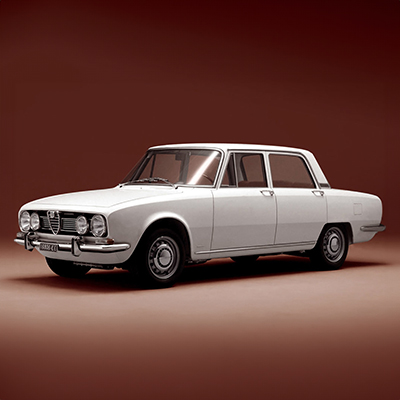
Bertone was commissioned to "clothe" these dimensions in a more modern shape that would, however, still show its ties to the Giulia; this is evident especially in the shape of the roof. Giugiaro, who followed the development of the 1750 up to the construction of the styling model, designed a smooth side characterized by a thin ribbing that starts at the rear wheel arch and straightens out above. The front and back views are simple and uncluttered. The grille, with double circular headlights of the same diameter, recalls the design of the Giulia Sport Special. Neither the engine hood nor the trunk has any decorative frills. After his first two Mazda attempts, Giugiaro made a brilliant show of the three-box four-door sedan theme with the 1750. And did so with a very modern and elegant sedan, so devoid of decorative motifs that it foreshadowed the idea of reduced-to-a-minimum shapes that was to culminate in the FIAT Uno.

Cookie Policy - Privacy Policy

We are available to ensure that those claimants, who could not be located, are credited with the video and photographic items on the site.

Giorgetto & Fabrizio Giugiaro © 2024 All rights reserved

Please rotate your device to portrait mode.