Alfetta GT/GTV

  • Brand: Alfa Romeo
  • Subtitle: 2+2 coupe to follow the success of Giulia GT
  • Intro: When it was presented in 1974, the Alfetta GT made quite a noise. But it stirred up a strange feeling too: it didn't look anything like a very recent Giugiaro creation.
  • Technical specifications:

    BRAND: Alfa Romeo

    MODEL: Alfetta GT/GTV

    YEAR: 1974

    BODY TYPE: Sports car

    POWER SUPPLY: Combustion

    CATEGORY: Production car

    DESIGNER: Giorgetto Giugiaro

  • Designer: Giorgetto Giugiaro
  • Time period: 1973/1980
  • Production: Production Car
  • Type: Sports Car
  • Power supply: Combustion

The car was built over the platform of the Alfetta sedan (that was to come out in 1972), and was successfully made and well-proportioned. The explanation lies in its inordinately lengthy development phase (six years), that brought it to the public only after the Scirocco, even though, historically-speaking, it is the Iguana's (1969) sister. The Alfetta is indeed a direct descendant of the Iguana: a look at the large back side window that is continued visually with a triangular air intake says it all.
Scirocco

  • Brand: Volkswagen
  • Subtitle: Highly successful economical sports car
  • Intro: Elegant and unadorned, like the FIAT 850 spider before it, the Scirocco highlights Giugiaro's ability to make even an economical sports car classy and refined.
  • Technical specifications:

    BRAND: Volkswagen

    MODEL: Scirocco

    YEAR: 1974

    BODY TYPE: Sports car

    POWER SUPPLY: Combustion

    CATEGORY: Production car

    DESIGNER: Giorgetto Giugiaro

  • Designer: Giorgetto Giugiaro
  • Time period: 1973/1980
  • Production: Production Car
  • Type: Sports Car
  • Power supply: Combustion

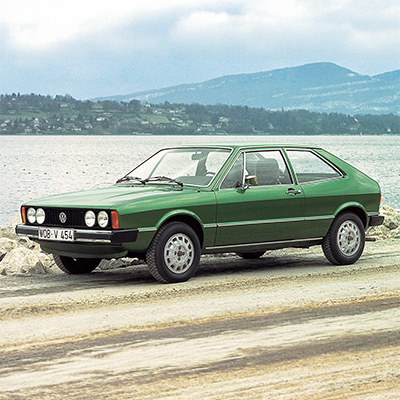
Born for limited production, the Scirocco was instead an overwhelming success: half a million units built, in its greatest moment of glory it was to reach a daily production rate of 420 cars. Its highly graphic design recalls the features of the Asso di Picche (although preceding it chronologically, having been designed first). The Scirocco was the first mass production car to use a rear hatch whose cut folds over onto the side. A true technological revolution, it was to be copied throughout the world. Historically speaking, though, the credit for this idea goes to the Golf design that, although it was officially presented a few months later, was born first thus deeply influencing the technical aspects of the Scirocco.

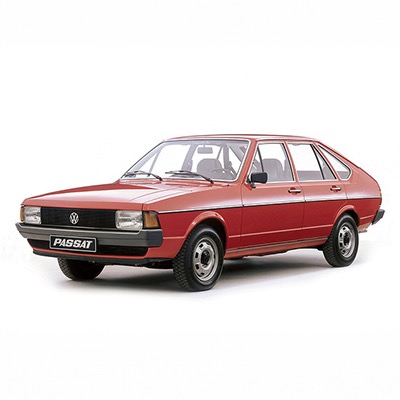
Passat

  • Brand: Vokswagen
  • Subtitle: The first generation of a large family
  • Intro: An automobile born at a time of transition and profound change, capable of revitalizing interest in the entire brand.
  • Technical specifications:

    BRAND: Vokswagen

    MODEL: Passat

    YEAR: 1973

    BODY TYPE: Sedan

    POWER SUPPLY: Combustion

    CATEGORY: Production car

    DESIGNER: Giorgetto Giugiaro

  • Designer: Giorgetto Giugiaro
  • Time period: 1973/1980
  • Production: Production Car
  • Type: Sedan
  • Power supply: Combustion

At the end of summer 1969, Gerhard R. Gumpert - Volkswagen's Italian importer - had been asked by Kurt Lotz, CEO of the German manufacturer, to explore the various opportunities offered by the Turin Motor Show to find someone who could help relaunch the brand with two new cars: the first model would be for the mid-size sector, with a newly-designed 1500 cc engine (the Passat, with either two or four doors), while the second model would be the one to take over from the Beetle and this would be the Golf.

On a style level, the model fell "victim" to several modifications, a compromise between the formal issues expressed on some of the research models carried forward by Giugiaro for the Audi and Volkswagen brands: initially, it was conceived as a version of the Golf but in a larger form (a change dictated by the desire to create a family identity between the two models). With the changes in Volkswagen's senior management and the arrival - at a time of economic crisis - of the new President Rudolf Leiding, the project was dramatically revised.

The range would see the fusion of the platform, the front end, and the door seal proposed for the Audi 80 with the rear boxes of the first "Maxi Golf" project and the rear windscreen ribs of the Golf and the Scirocco. Despite development and production complications, the Passat was a resounding commercial success: from 1973 to 1980, in the sedan and station wagon versions, over 2 million units were produced.

Asso di Picche

  • Brand: Audi Karmann
  • Subtitle: Four-seater coupe with a graphic, eye-catching shape
  • Intro: Karmann asked Giugiaro for a four-seater coupe for the Frankfurt Show of 1973.
  • Technical specifications:

    BRAND: Audi Karmann

    MODEL: Asso di Picche

    YEAR: 1973

    BODY TYPE: Sports car

    POWER SUPPLY: Combustion

    CATEGORY: Concept car

    DESIGNER: Giorgetto Giugiaro

  • Designer: Giorgetto Giugiaro
  • Time period: 1973/1980
  • Production: Concept Car
  • Type: Sports Car
  • Power supply: Combustion

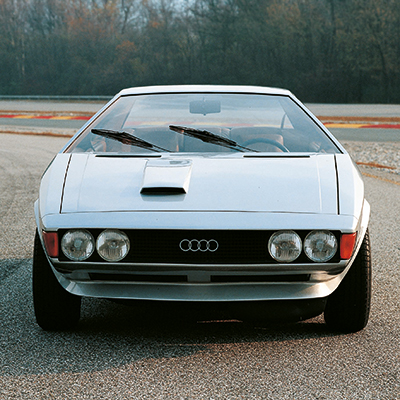
As with the Cheetah, an existing platform and mechanical assembly (those of the Audi 80) were to be used, and a shape laid out that, while rich in forward-looking touches, would lend itself to limited production. Giugiaro took off from the geometrical features of the Boomerang the trapeziums, tracing out an extremely graphic, eye-catching shape. While keeping the length of the Audi 80 unchanged, he worked on the overhangs, shortening the one at the rear and lengthening the front one to give more rake to the car. The Asso di Picche was very clearly to influence the design of the Delta (1979): the treatment of the surface areas is identical, as is the cross-section.

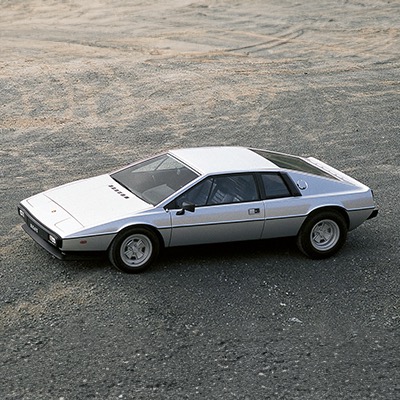
Esprit

  • Brand: Lotus
  • Subtitle: It all starts with the Silver Car
  • Intro: The Esprit embodies the lightness typical of all Lotus models, and it stands out with its sharp lines and wedge-shaped profile, instantly becoming a classic.
  • Technical specifications:

    BRAND: Lotus

    MODEL: Esprit

    YEAR: 1972

    BODY TYPE: Sports car

    POWER SUPPLY: Combustion

    CATEGORY: Production car

    DESIGNER: Giorgetto Giugiaro

  • Designer: Giorgetto Giugiaro
  • Time period: 1968/1972
  • Production: Production Car
  • Type: Sports Car
  • Power supply: Combustion

Colin Chapman, the founding father of Lotus Cars Ltd. and the Formula 1 team, asked Giugiaro to develop an aerodynamic supercar with a two-shell fiberglass body, intended for standard production by the Norwich automotive company using aeronautics-inspired technology.

The design of the two external half-shells, which overlap like a nut midway along the waistline, presents the special plastic processing technology adopted in the Lotus navy division. In terms of design, this project benefited from the positive input of the Maserati Boomerang. Again, the wedge shape and the tilt of the windshield are excessive at 18 degrees for a model intended for the production of thousands of vehicles.

Like lightning, the Esprit enlivened the automotive scene and when, just a little while later, it faced the sea with James Bond behind the wheel (Roger Moore in “A Spy Who Loved Me”) even the least-prepared audience was forced to get to know the Lotus brand.

Powered by a four-cylinder twin-cam engine displacing 1973 cc (160 bhp at 4900 rpm), the car was first presented at the 1972 Turin Motor Show and went into production in June 1976 with a declared weight of 900 kg and a maximum speed of 222 kph. In various versions and a series of updates, the Esprit was produced from 1976 to 2004 in a total of 10,675 examples.

Cookie Policy - Privacy Policy

We are available to ensure that those claimants, who could not be located, are credited with the video and photographic items on the site.

Giorgetto & Fabrizio Giugiaro © 2024 All rights reserved

Please rotate your device to portrait mode.