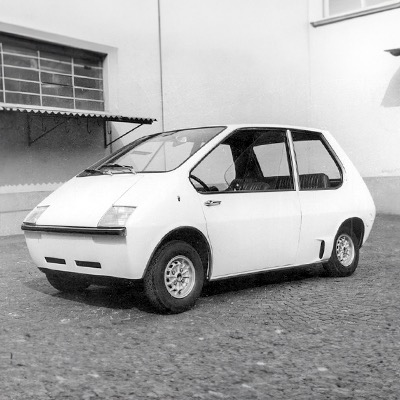
Microutilitaria

  • Brand: Suzuki
  • Subtitle: A prototype with a truly innovative shape
  • Intro: To achieve this result, Giugiaro repeated the concept expressed in 1967 in the Rowan Elettrica.
  • Technical specifications:

    BRAND: Suzuki

    MODEL: Microutilitaria

    YEAR: 1969

    BODY TYPE: Citycar

    POWER SUPPLY: Combustion

    CATEGORY: Concept car

    DESIGNER: Giorgetto Giugiaro

  • Designer: Giorgetto Giugiaro
  • Time period: 1968/1972
  • Production: Concept Car
  • Type: Citycar
  • Power supply: Combustion

Suzuki considered Giugiaro's proposal too advanced and chose to use it as a starting point for the Fronte coupe presented two years later and subsequently mass produced. This small coupe takes up many ideas of shape of the Giugiaro sub-subcompact, but in a classic architecture where hood, windshield and roof make a definite break.
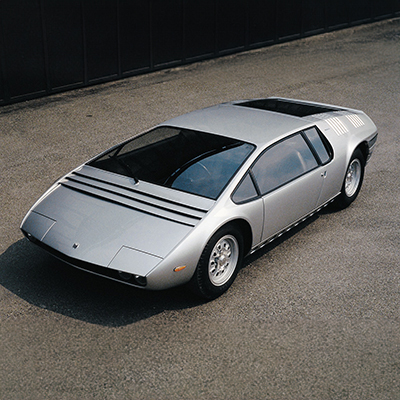
Manta

  • Brand: Bizzarrini
  • Subtitle: More than an MPV, a single line
  • Intro: An extreme prototype, to arouse the interest of public and media, a demonstration of the in-house capabilities of Giugiaro’s newly born company.
  • Technical specifications:

    BRAND: Bizzarrini

    MODEL: Manta

    YEAR: 1968

    BODY TYPE: Sports car

    POWER SUPPLY: Combustion

    CATEGORY: Concept car

    DESIGNER: Giorgetto Giugiaro

  • Designer: Giorgetto Giugiaro
  • Time period: 1968/1972
  • Production: Concept Car
  • Type: Sports Car
  • Power supply: Combustion

For the debut at the 1968 Turin Motor Show, Giugiaro built his company's first prototype, the Manta Bizzarrini. As soon as he started its own entrepreneurial venture Giorgetto decided that in addition to departments working on clients' orders, he would also build up a research section for prototypes of his own. As Giugiaro states, a designer definitely needs this back-up to demonstrate his in-house capabilities.

The Manta was built on a chassis that Giotto Bizzarini had "blueprinted" from a Grifo Competizione. The designer immediately started by taking the vehicle's profile to the extreme: a continuous line from the front end to the roof with no break for the valance: the inclination of the windshield stopped at just 15 degrees, despite the effect on interior visibility. This was the first sports MPV with a provocative height of 1,050 mm, which also offered an unusual layout with three seats side by side and a central driving position. From the front, the rounded hood combined with the flat, wide mass clearly demonstrated the inspiration behind the shape of this marine model.

In the 1960s and 1970s, these concept cars, as we would call them now, were “dream cars”, to arouse the interest of the media and stimulate the imagination of a young, enthusiastic public. People's minds were still to some extent anchored in the immediate postwar years, but the need for optimistically designed stimuli was evident, everywhere, and Giugiaro was able to grasp it and feed it.

Ghibli Spyder

  • Brand: Maserati
  • Subtitle: A visual delight, the spider by definition
  • Intro: The Maserati Ghibli Spyder became a universally recognized and sought-after classic.
  • Technical specifications:

    BRAND: Maserati

    MODEL: Ghibli Spyder

    YEAR: 1967

    BODY TYPE: Sports car

    POWER SUPPLY: Combustion

    CATEGORY: Production car

    DESIGNER: Giorgetto Giugiaro

  • Designer: Giorgetto Giugiaro
  • Time period: 1966/1967
  • Production: Production Car
  • Type: Sports Car
  • Power supply: Combustion

The clean lines that characterized the Maserati Ghibli gave Giorgetto Giugiaro a reputation as the undisputed master of automotive design. The coupé's classic proportions in its front-engine configuration, elongated hood and sharply angled windshield could be perfectly adapted to an open spider version.

The Ghibli Spyder was a two-seater: the canvas soft top folded perfectly out from under the rear panel, behind the seats, and could be raised or lowered in minutes. A hard top with large windows made the car practical and suitable for all-weather travel. Along with the Maserati Simun concept car, the Ghibli Spyder was one of the last projects Giugiaro designed for Ghia in 1967 before founding his own consulting firm. Like the coupe model, the Ghibli Spyder was available in both a standard 4.7-liter version and an upgraded 4.9-liter version for the Spider SS.

Of the 125 Ghibli Spyders sold over the five years the model was available, only one-fifth were made as SS versions. This resulted in this car becoming a universally recognized and sought-after classic. Upon request, it was possible to equip the car with an automatic transmission, and a significant number of Ghibli were sold with this set-up, since the United States was the model's main market.

As the years went by, the Ghibli Spyders "multiplied": compared to the 125 examples produced, more were added by transforming the standard Maserati Ghibli, of which about 1,200 were made, by cutting the roof.

Fidia S4

  • Brand: Iso Rivolta
  • Subtitle: An high-performance sedan
  • Intro: The car was a triumph of elegance and quietness: an example of combining European design with an American heart.
  • Technical specifications:

    BRAND: Iso Rivolta

    MODEL: Fidia S4

    YEAR: 1967

    BODY TYPE: Sedan

    POWER SUPPLY: Combustion

    CATEGORY: Production car

    DESIGNER: Giorgetto Giugiaro

  • Designer: Giorgetto Giugiaro
  • Time period: 1966/1967
  • Production: Production Car
  • Type: Sedan
  • Power supply: Combustion

In 1967, ISO Rivolta tackled the emerging market for high-performance sedans by launching the S4 (code name: "Four Hatches"), later known as the Fidia.

Piero Rivolta asked Giorgetto Giugiaro to interpret his idea of a sedan in a way that perfectly represented the DNA of the Bresso-based company.

The young designer had just arrived at Ghia, at that time owned by Alejandro De Tomaso, a longtime friend of Piero's, as chief designer. Giugiaro adapted his Grifo concept, which he himself had designed while still at Bertone, into a four-door sedan, characterized by the idea of speed, elegance and power. A perfect synthesis.

The car remained the same as its predecessor, the IR300/340, with a 5358cm³ four-barrel carbureted Chevrolet V8 engine (offered in both 300hp and 350hp configurations).

The company then struggled to find a suitable name for the newborn: eventually “Fidia” is chosen, to honor the famous Greek architect and sculptor who designed the Parthenon in Athens, chosen as the setting for the car's presentation to the international press.

The car was a triumph of elegance and quietness: no drafts, clean lines and leather interior. An exclusive environment to drive in safety. Not to be outdone, it was another example of combining European design with an American heart.

Production of the Fidia began in 1968 and ended in December '74, with the closure of Iso. A total of 192 examples were built. The Fidia was the personal car of musician John Lennon, who owned three examples.

Rowan

  • Brand: De Tomaso
  • Subtitle: Not the electric city car you expect
  • Intro: An extremely futuristic project, far ahead of its time.
  • Technical specifications:

    BRAND: De Tomaso

    MODEL: Rowan

    YEAR: 1967

    BODY TYPE: Citycar

    POWER SUPPLY: Electric

    CATEGORY: Concept car

    DESIGNER: Giorgetto Giugiaro

  • Designer: Giorgetto Giugiaro
  • Time period: 1966/1967
  • Production: Concept Car
  • Type: Citycar
  • Power supply: Full-electric

Among the projects completed during the two years at Ghia by Giorgetto Giugiaro was the De Tomaso Rowan.

In 1967 the first electric research study created by a Turin-based coachbuilder was ready to be launched. The research was sponsored by the battery manufacturer Rowan Controller Company headquartered in Maryland, which had become Ghia's main shareholder.

Profoundly different from the typical sports cars of those years, the Rowan is a five-seat all-electric city car, powered by a General Electric motor, with eight six-volt lead-acid accomulators, and a very low weight (less than 1400 pounds without the batteries). The car exposed a series of complexities for which concrete solutions have only been found in recent decades.

Cookie Policy - Privacy Policy

We are available to ensure that those claimants, who could not be located, are credited with the video and photographic items on the site.

Giorgetto & Fabrizio Giugiaro © 2024 All rights reserved

Please rotate your device to portrait mode.