Corvair Testudo

  • Brand: Chevrolet
  • Subtitle: A calling card for the future
  • Intro: Giugiaro's dream car will leave a long legacy on future concept and granturismo cars in the decades to come.
  • Technical specifications:

    BRAND: Chevrolet

    MODEL: Corvair Testudo

    YEAR: 1962

    BODY TYPE: Sports car

    POWER SUPPLY: Combustion

    CATEGORY: Prototype

    DESIGNER: Giorgetto Giugiaro

  • Designer: Giorgetto Giugiaro
  • Time period: 1955/1965
  • Production: Concept Car
  • Type: Sports Car
  • Power supply: Combustion

In 1962 many coachbuilders began to consider creating Corvair-based concepts, given an ongoing debate in the United States over the safety of the model produced by Chrevolet. Among them was Bertone, eager to make a name for itself overseas. At the same time, GM itself wants to promote the Corvair on the Old Continent with proposals designed for the European market, so much so that for many it is Bill Mitchell himself, director of the GM Style Center, who is supplying the chassis to the various body shops.

Having come into possession of the chassis in the winter of 1962, Nuccio is determined to build a Corvair-based prototype in time for the traditional early March Geneva Motor Show. The schedule is tight and Nuccio entrusts the task of developing the concept to Giugiaro without placing any constraints on him: Giorgetto will have to think not only about styling, but also about trying to make up for the original model's shortcomings in stability and road holding.

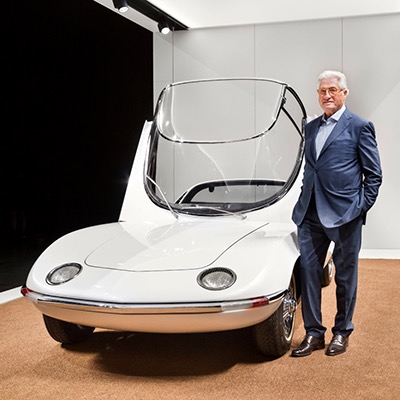
Giugiaro starts by shortening and reinforcing the Corvair Monza's chassis, while he has to leave unchanged the mechanicals consisting of the aforementioned 2.4-liter 6-cylinder boxer mounted at the rear. On the other hand, to increase dynamics he lowers the center of gravity and intervenes on the weight distribution by lightening the front end to give more "grip" to the rear-wheel drive. For styling, the young designer opts for rounded shapes that enhance aerodynamics including the side. The line is divided in two by the demarcation along the side with the upper part resembling the shell of a tortoise. An assonance that gives the prototype its name, Testudo, the Latin name for tortoise.

The presentation at the Geneva Motor Show is a success, the consensus unanimous: what impresses are the low profile (it is only 106 cm high) and streamlined, very balanced as a whole and with a long hood that, unlike other "all behinds," such as the Alpine A110 or the Porsche 356, suggests the presence of the engine in the front. Also pleasing are the two domes for access to the engine compartment and into the cabin, with the latter hinged in front and with a wraparound windshield and transparent Plexiglas roof. Other styling innovations include round front light clusters that swivel upward and rear light clusters, made of polycarbonate for the first time, built into the bumpers.

The beauty of the Testudo thunderstruck Ferruccio Lamborghini, who in the following years entrusted Bertone with the styling of many of his successful models, starting with the Miura: what would become the Taurus' most celebrated supercar incorporated many of the styling solutions conceived for the Testudo, such as the retractable headlights or the design of the air intakes on the sides of the windows. Then again, Giugiaro's dream car will leave a long legacy on future concept and granturismo cars in the decades to come.

300/340 GT

  • Brand: Iso Rivolta
  • Subtitle: A refined, comfortable, elegant GT
  • Intro: A milestone in the history of the Italian automobile, a powerful car with high build quality and elegant lines.
  • Technical specifications:

    BRAND: Iso Rivolta

    MODEL: 300/340 GT

    YEAR: 1962

    BODY TYPE: Sports car

    POWER SUPPLY: Combustion

    CATEGORY: Production car

    DESIGNER: Giorgetto Giugiaro

  • Designer: Giorgetto Giugiaro
  • Time period: 1955/1965
  • Production: Production Car
  • Type: Sports Car
  • Power supply: Combustion

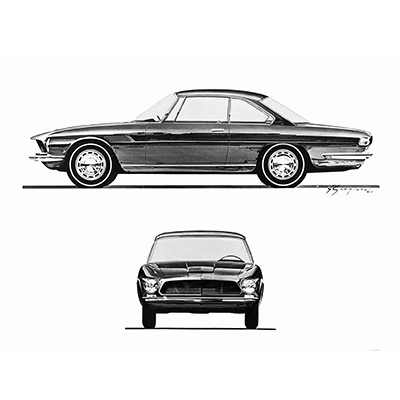
The Iso Rivolta 300 is a high-performance sports car produced by Iso Rivolta from 1962 to 1970 in 800 examples. At the time of its launch, the model was named GT 300. Later the car was renamed IR 300, and some examples were equipped with a 340-hp engine.

Renzo Rivolta, president of the almost eponymous car manufacturer, and his collaborator, engineer Giotto Bizzarrini, formerly at Ferrari, conceived the car as a Gran Turismo in the original sense of the term. Iso Rivolta's goal was to build a powerful car with high build quality and elegant lines.

Renzo Rivolta chose a reliable and very powerful 5.3-liter V8 from the Chevrolet Corvette, good for 300 hp at only 5,000 rpm, going against the national trend that favored small-displacement engines, which gave the best performance at high revs. This was a milestone in the history of the Italian automobile, because it was the first example of offering on the market in the Belpaese a Gran Turismo along the lines of, for example, the French Facel Vega.

The elegant Gran Turismo debuted in 1962 at a special event at Villa Rivolta in Bresso, in the presence of the American Consul and General Motors management. An innovative body designed by Bertone together with the young Giorgetto Giugiaro, it combined comfort (enough space for four adults), speed and reliability.

250 GT Bertone

  • Brand: Ferrari
  • Subtitle: One of a kind
  • Intro: A unique model that showcases the talent of the still very young Giorgetto Giugiaro.
  • Technical specifications:

    BRAND: Ferrari

    MODEL: 250 GT Bertone

    YEAR: 1962

    BODY TYPE: Sports car

    POWER SUPPLY: Combustion

    CATEGORY: Concept car

    DESIGNER: Giorgetto Giugiaro

  • Designer: Giorgetto Giugiaro
  • Time period: 1955/1965
  • Production: Concept Car
  • Type: Sports Car
  • Power supply: Combustion

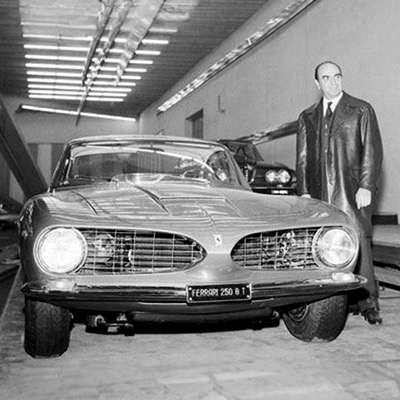
The 1962 Ferrari was commissioned to a very young Giorgetto Giugiaro, then 24 and in his first assignments after his youthful experience at Fiat's Centro Stile, who created what would become the personal car of Bertone, heir to the Turin-based coachbuilder of the same name. The model followed an earlier version of the 250 GT also made by Nuccio Bertone in 1960 for a Genoese entrepreneur.

The Berlinetta Speciale is based on a 250GT SWB, which like many other Ferraris of the time lent itself to interpretations made by the most fashionable coachbuilders: the customer bought a car and the coachbuilder thought about modifying the exterior, transforming it from a car like any other into a unique jewel.

Inspired by Ferrari's world-championship-winning Grand Prix car, the 156 F1, as well as the 330 TRI LM and 246 SP sports racing cars, Bertone and Giugiaro twisted the outline of the 250GT SWB and designed an arrow-shaped nose, inspired by the "nose" of a shark, which harked back to Ferrari racing cars and added a hint of liveliness to a line that appeared elegant and very clean, especially in the front area: the headlights are recessed in the grille and no longer separated as on the 250GT SWB, which instead has a soft rear end compared to the more "dry" rear end of the Berlinetta Speciale.

Consistent with the sharknose theme, the bodywork featured several competition-inspired cues, including a Plexiglas bug deflector, a wide hood scoop, drilled rocker trim, and a small trail of louvers following the line created by the rear quarter windows. As in the standard design, the Bertone 250 SWB had extractor vents on the front and rear fenders. While Pinin Farina’s vents were purely functional vertically oriented slashes, Bertone’s were horizontally oriented, oval shaped, and trimmed with decorative slats. Viewed from any angle, the sharknose 250 SWB was an absolutely gorgeous automobile, with voluptuous forms, beautiful flowing lines, and compact, aggressive proportions.

Nuccio Bertone was obviously very proud of his Berlinetta Speciale, and he introduced it at the prestigious Geneva Auto Show on March 1962, where it was greatly admired.

1000/1200 S Coupé

  • Brand: Simca
  • Subtitle: A budget sports car for a young audience
  • Intro: The Simca Coupé 1000 and its successor, the Simca 1200S are small, rear-engined two-door coupes which were produced by the French automaker Simca between 1962 and 1971.
  • Technical specifications:

    BRAND: Simca

    MODEL: 1000/1200 S Coupé

    YEAR: 1962

    BODY TYPE: Sports car

    POWER SUPPLY: Combustion

    CATEGORY: Production car

    DESIGNER: Giorgetto Giugiaro

  • Designer: Giorgetto Giugiaro
  • Time period: 1955/1965
  • Production: Production Car
  • Type: Sports Car
  • Power supply: Combustion

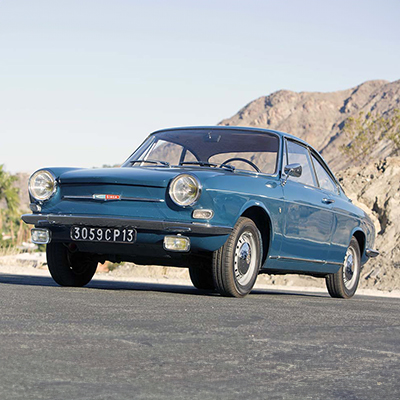
Despite sharing its chassis and mechanical elements with the boxy Simca 1000 saloon, the Coupé, whose body design was commissioned from Bertone and realized by Giugiaro, was able to offer superior road holding and performance because its centre of gravity was lower and its shape more aerodynamic.

1000 GT Coupé

  • Brand: Asa
  • Subtitle: Better known as the Ferrarina
  • Intro: The ASA 1000 GT is a small sports car built by the Milanese company ASA from 1962 to 1967, in coupe and spider versions.
  • Technical specifications:

    BRAND: Asa

    MODEL: 1000 GT Coupé

    YEAR: 1961

    BODY TYPE: Sports car

    POWER SUPPLY: Combustion

    CATEGORY: Production car

    DESIGNER: Giorgetto Giugiaro

  • Designer: Giorgetto Giugiaro
  • Time period: 1955/1965
  • Production: Production Car
  • Type: Sports Car
  • Power supply: Combustion

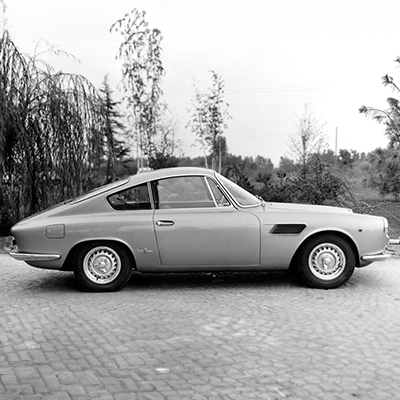
At the 1961 Turin Motor Show, a new concept car with a mysterious tricolor logo appeared on Bertone's stand. The engine study had been carried out by Carlo Chiti, while the chassis design had been entrusted to Giotto Bizzarrini and the bodywork to Bertone based on a design by Giorgetto Giugiaro. The design had been intended for Ferrari, but after various deliberations Enzo Ferrari declined it. The production outlet was solved by the proposal of Oronzio De Nora, a Milanese industrialist in the electrochemical sector who, under pressure from his son Niccolò, was intent on entering the automotive field. For this purpose, the company ASA was established, chaired by Niccolò De Nora and based in Lambrate, then an industrial suburb of Milan, adjacent to the De Nora factories. The technical-structural deficiency of the newly formed ASA was made up for by Ferrari with the supply of chassis and engines and Bertone for the body and final assembly. The transfer of the project stipulated that the Ferrari trademark should not appear on any part of the car, but to the enthusiast public it immediately became known as the Ferrarina. Production of the new coupe actually began in 1963 at Bertone factories, and the car was distributed using Ferrari's sales network.

Cookie Policy - Privacy Policy

We are available to ensure that those claimants, who could not be located, are credited with the video and photographic items on the site.

Giorgetto & Fabrizio Giugiaro © 2024 All rights reserved

Please rotate your device to portrait mode.